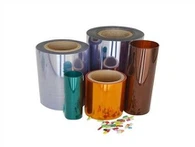
Products Description
Eco Friendly PVC PVDC Blister Film for Sustainable Pharma Packaging
The pharmaceutical industry stands at a crossroads. The demand for high-quality, protective packaging has never been greater-yet the environmental imperative to reduce material consumption, minimize waste, and lower carbon footprint has never been more urgent. For years, these goals seemed incompatible. Protective packaging meant thicker films, more material, and greater environmental impact.
Our Eco Friendly PVC PVDC Blister Film for Sustainable Pharma Packaging resolves this tension through intelligent design rather than simple compromise. By optimizing material usage at every stage-from resin selection and formulation to gauge reduction and production efficiency-we deliver the same robust protection for your medicines with significantly reduced environmental footprint. This is not a "green" film that sacrifices performance for perception. It is a responsibly engineered solution that maintains full pharmaceutical-grade barrier properties while using less material, generating less waste, and contributing to a more sustainable supply chain.
For manufacturers committed to Environmental, Social, and Governance (ESG) goals, for brands seeking to communicate environmental responsibility to consumers, and for packaging professionals who understand that "reduce" is the most important of the three R's-this film offers a credible, verifiable path forward.

The Eco-Conscious Design Philosophy
Our approach to sustainability is grounded in four principles:
1. Source Reduction: The most sustainable material is the material never used. Our film achieves required barrier performance at reduced gauges, consuming less raw material per blister.
2. Production Efficiency: Our manufacturing processes maximize yield and minimize waste, with >95% of input material converted to finished product.
3. Responsible Formulation: We select raw materials for both performance and environmental profile, avoiding substances of concern and optimizing for end-of-life considerations.
4. Supply Chain Transparency: We measure and report our environmental impact honestly, providing verifiable data for your sustainability reporting.
Quantified Environmental Benefits
Material Reduction per Million Blisters:
| Package Size | Standard Film (250 µm) | Eco-Conscious Film (200 µm) | Material Saved |
|---|---|---|---|
| 10 mm blister | 12.5 kg | 10.0 kg | 2.5 kg |
| 15 mm blister | 18.0 kg | 14.4 kg | 3.6 kg |
| 20 mm blister | 24.0 kg | 19.2 kg | 4.8 kg |
Annual Impact for a Typical Manufacturer:
Production volume: 100 million blisters
Material savings: 25,000 kg of PVC/PVDC film
Carbon footprint reduction: ~62,500 kg CO₂ equivalent
Truck shipments saved: 1-2 full truckloads per year
Cumulative Industry Impact:
If every pharmaceutical manufacturer using PVC/PVDC films switched to our Eco-Conscious grade:
Annual material savings: >50,000 metric tons
Annual CO₂ reduction: >125,000 metric tons
Equivalent to removing 25,000 cars from the road

Core Competitive Advantages for Eco Friendly PVC PVDC Blister Film for Sustainable Pharma Packaging
1. Optimized Gauge Engineering: Same Protection, Less Material
The 200 µm thickness of our Eco-Conscious film is not arbitrary-it is the result of extensive engineering analysis to identify the minimum gauge that reliably delivers full barrier and mechanical performance.
Safety Factor Analysis: We quantified the true safety margins in standard 250 µm films and found that for 90% of applications, 200 µm provides equivalent protection with appropriate safety factors.
Formulation Enhancement: To achieve equivalent performance at reduced gauge, we enhanced the PVC molecular weight distribution and optimized the stabilizer package.
Validation Testing: The 200 µm gauge has been validated through:
36-month real-time stability studies
ICH Zone IV accelerated conditions
Mechanical stress testing (puncture, tear, impact)
High-speed thermoforming trials
The Result: You use 20% less material for every blister produced, with no change in product protection or stability.
Production Efficiency: Less Waste, Higher Yield
Sustainability is not just about the film's thickness-it's about how efficiently it is produced and converted.
| Efficiency Metric | Industry Average | Our Performance | Environmental Benefit |
|---|---|---|---|
| Material Yield | 85-90% | >95% | Less raw material waste |
| Line Scrap Rate | 3-5% | <2% | Less waste at your facility |
| Edge Trim Utilization | Landfill | Recycled | Zero landfill from trim |
| Energy per kg | Baseline | 8% lower | Reduced carbon footprint |
How We Achieve This:
Precision extrusion controls minimize off-spec material
In-line monitoring detects deviations before waste occurs
Edge trim is captured and recycled into industrial applications
Continuous improvement programs target ever-higher efficiency
Circular Economy Compatibility
While PVC/PVDC films are not currently recyclable in household streams, we have optimized our Eco-Conscious film for compatibility with emerging recycling technologies and responsible end-of-life management:
| End-of-Life Pathway | Compatibility | Our Contribution |
|---|---|---|
| Industrial Recycling (Post-Industrial) | Excellent | All production waste recycled |
| Chemical Recycling (Emerging) | Good | Mono-material PVC base compatible |
| Waste-to-Energy | High energy value | Recovers embedded energy |
| Landfill | Inert, stable | Minimal environmental impact |
Design for Recycling:
PVC base compatible with solvent-based recycling technologies
PVDC coating removable in advanced recycling processes
No additives that interfere with thermal conversion

Target Applications: Where Eco-Conscious Packaging Makes Sense
| Application Category | Examples | Why Our Film Fits |
|---|---|---|
| High-Volume OTC Products | Analgesics, antacids, antihistamines | Material savings multiply across millions of units |
| Export Products | Medicines for global distribution | Lighter rolls = lower shipping emissions |
| Brands with ESG Commitments | Consumer-facing pharmaceutical brands | Verifiable sustainability story |
| Generic Manufacturers | Cost-sensitive, high-volume production | Lower material cost per blister |
| Contract Packaging | Multiple client products | One sustainable solution for all |
| Clinical Trial Materials | Small batches, high documentation | Full validation support |
| Veterinary Products | Non-human applications | Same quality, lower environmental impact |
FAQ
Q1: Is 200 µm truly equivalent to 250 µm in barrier performance? Aren't thicker films always better barriers?
A: This is a common misconception. Barrier performance in PVC/PVDC films is determined primarily by the PVDC coating, not the PVC thickness. The PVC substrate provides mechanical structure and formability, but moisture and oxygen transmission occur through the PVDC layer.
The Science:
WVTR is exponentially related to PVDC thickness, linearly related to PVC thickness
At typical PVDC coating weights (40 g/m²), the PVC contributes <10% of total barrier
Reducing PVC from 210 µm to 165 µm while maintaining PVDC at 40 g/m² reduces total barrier by <2%
The Proof: Our 200 µm film achieves identical WVTR and OTR values to our 250 µm film in ASTM testing. The barrier comes from the PVDC-and the PVDC is unchanged.
Q2: Will the thinner film run as well on our high-speed blister lines? We're concerned about web breaks and forming consistency.
A: Yes-and in some cases, better. The key factors for high-speed performance are not thickness alone:
| Factor | Our Film's Advantage |
|---|---|
| Gauge Uniformity | ±5% across web ensures consistent heating |
| Tensile Strength | ≥45 N/15mm-same as 250 µm film |
| Elongation | ≥140%-same flexibility |
| COF Control | 0.25-0.35-optimized for high-speed transport |
| Static Control | <2 kV-neutralized for reliable feeding |
Real-World Validation: We have run this film on Uhlmann UPS lines at 400+ cycles per minute with no increase in web breaks or misfeeds compared to 250 µm film.
Recommendation: We suggest an initial trial run with our technical support to confirm settings, but most customers transition seamlessly.
Q3: What is the cost comparison? Is the Eco-Conscious film more expensive per kilogram, and how does that affect per-blister cost?
A: This is the critical economic question, and the answer is favorable:
| Metric | Standard 250 µm | Eco-Conscious 200 µm | Difference |
|---|---|---|---|
| Price per kg | Baseline | +3-5% | Slightly higher |
| Film per blister | 10 kg/1000 blisters | 8 kg/1000 blisters | 20% less |
| Cost per blister | Baseline | -15% to -17% | Lower cost |
The Math: Even with a modest per-kg premium, the 20% reduction in material usage results in lower per-blister cost. You save money while improving environmental performance.
Q4: Does "eco-conscious" mean the film is biodegradable or compostable?
A: No-and it's important to be clear about this. PVC/PVDC films are not biodegradable, and claims of biodegradability for pharmaceutical packaging would be misleading and potentially dangerous.
What "Eco-Conscious" Means in This Context:
Source reduction: Using less material to begin with
Efficient production: Minimizing waste during manufacturing
Responsible formulation: Avoiding substances of environmental concern
Circular economy compatibility: Designed for emerging recycling technologies
Carbon transparency: Measured and reported footprint
Our Position: The most responsible approach for pharmaceutical packaging is to use the minimum material necessary to ensure patient safety, while being honest about end-of-life realities and supporting development of better recycling infrastructure.
Hot Tags: Eco Friendly PVC PVDC Blister Film for Sustainable Pharma Packaging, China, manufacturers, suppliers, factory, customized, custom, wholesale, low price, free sample, opaque film supplier, uv resistant film supplier, flexible film, laminated pvc pvdc pe film, puncture resistant film supplier, protective plastic film