


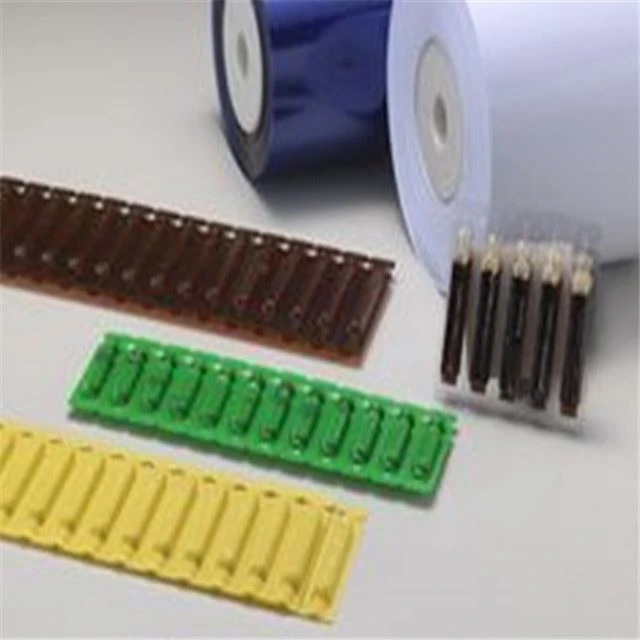


PVC PE Suppository Packaging Film Pharma Grade
PVC PE Suppository Packaging Film Pharma Grade is a pharmaceutical-grade blister film specifically engineered for the demanding requirements of suppository packaging. Unlike standard tablet blister films, suppository packaging must accommodate larger cavity depths, withstand contact with fatty bases (cocoa butter, Witepsol, hard fat), and maintain seal integrity despite potential lipid contamination on sealing surfaces.
This pharma-grade film combines a rigid PVC thermoforming layer with a lipid-resistant PE sealant layer, providing the structural integrity needed for deep-draw cavities while ensuring reliable sealing with aluminum lidding. The PE layer acts as a chemical barrier, preventing the suppository base from migrating into the PVC and causing swelling or stickiness – a common failure mode in suppository packaging.
PVC PE Suppository Packaging Film Pharma Grade is manufactured under ISO 15378:2017 (GMP for pharmaceutical primary packaging materials) with full batch traceability and regulatory documentation for global pharmaceutical submissions.
▸ The Suppository Packaging Challenge – And How This Film Solves It
| Packaging Challenge | Why It's Critical | How PVC PE Suppository Packaging Film Pharma Grade Addresses It |
|---|---|---|
| Lipid Base Contact | Cocoa butter/Witepsol can extract PVC plasticizers → film becomes sticky and weak | PE layer acts as a lipid barrier – no plasticizer migration, no stickiness |
| Deep Cavity Requirement | Suppositories are large (1–3g) – cavities up to 14mm deep | Rigid PVC with optimized forming characteristics draws deep without cracking |
| Cold Filling | Suppositories are filled at 5–10°C to maintain solid form | Film remains flexible at low temperatures – no brittleness |
| Seal Contamination | Fatty residue on seal surface can weaken seals | PE-to-lidding seals maintain integrity despite trace lipid contamination |
| Product Visibility | Some suppositories require visual inspection | Clear grade available with haze <5%; amber/white for light-sensitive APIs |
| Regulatory Compliance | Suppository packaging must meet pharma GMP standards | ISO 15378 certified – full documentation for regulatory submissions |
▸ Technical Specifications
| Parameter | Specification |
|---|---|
| Structure | PVC (rigid thermoformable base) + PE (lipid-resistant sealant) |
| Total Thickness | 250–350 µm (cavity depth dependent) |
| PVC Layer | 220–300 µm (rigid, high clarity or pigmented) |
| PE Layer | 20–40 µm (lipid-resistant, low COF sealant) |
| Color Options | Clear (standard), Amber (UV block), White (total light block) |
| Haze (clear grade) | <5% |
| UV Transmission (amber, 400nm) | <5% |
| Visible Transmission (white) | <3% |
| WVTR | 6–10 g/m²·day (PVC barrier only – sufficient for lipid-based suppositories) |
| OTR | 20–30 cm³/m²·day |
| Thermoforming Temperature | 120–145°C |
| Sealing Temperature (with Alu lidding) | 135–155°C |
| Seal Strength (push-through) | ≥20 N/15mm |
| Seal Strength (peelable) | 8–15 N/15mm |
| Maximum Cavity Depth | 14mm |
| Low-Temperature Flexibility | Pass at 5°C |
| Lipid Resistance (cocoa butter, 30 days, 40°C) | Weight change <0.5%; no surface degradation |
| Roll Width | 100–800 mm |
| Core Diameter | 76mm (3") or 152mm (6") |
| Roll Length | Up to 2000m |

Why PVC PE – The Rationale for Suppository Packaging
PVC PE Suppository Packaging Film Pharma Grade uses a two-layer structure specifically chosen for suppository applications:
| Layer | Function | Why It's Critical for Suppositories |
|---|---|---|
| PVC (Rigid Base) | Thermoforming, cavity formation | Provides the rigidity needed for deep draws (large suppositories) and maintains cavity shape during filling |
| PE (Sealant) | Sealing to lidding, lipid resistance | PE does not absorb fatty bases – prevents seal failure and package weeping |
| Optional Pigments | Light protection | Amber for UV-sensitive APIs; white for total light block |
Why not use PVC/PVDC for suppositories?
PVDC is an excellent moisture barrier but adds cost that is unnecessary for most suppository formulations (which are lipid-based and not moisture-sensitive).
PVDC-coated films have higher sealing temperatures – risk of melting the suppository base.
PE provides better lipid resistance than PVDC.
Why not use PVC alone (no PE layer)?
PVC surface has higher COF – may stick to sealing bars.
PVC seals are less reliable with fatty contamination.
PVC may absorb small amounts of lipid over time.
PVC PE Suppository Packaging Film Pharma Grade offers the optimal cost-performance balance – PE seal layer for reliable sealing and lipid resistance, PVC base for thermoforming, no expensive PVDC barrier that suppositories don't need.
Key Features – Suppository-Specific Design
Deep Draw Capability – Forms cavities up to 14mm to accommodate large (3g) suppositories without cracking or excessive thinning. Standard PVC films often fail at >10mm.
Cold Filling Compatibility – Remains flexible at 5–10°C (typical suppository filling temperatures). No brittleness or cracking during cold handling.
Lipid-Resistant PE Layer – Does not absorb cocoa butter, Witepsol, or other fatty bases. Prevents swelling, surface stickiness, and seal contamination.
Secure Seal with Fatty Residue – PE-to-lidding seal maintains integrity even if trace amounts of lipid are present on the seal surface. Tested with cocoa butter-contaminated seals.
Pharma-Grade Compliance – Manufactured under ISO 15378:2017 (GMP for pharmaceutical primary packaging). Full batch traceability and regulatory documentation.
Color Options for Light-Sensitive APIs – Clear (standard), Amber (UV-blocking), White (total light block). Amber and white grades available with same PE seal layer.
Print-Ready Outer Surface – Reverse printing on PVC outer layer. White/amber background provides excellent contrast for printed information.

Quality Assurance – Suppository-Specific Testing
In-Process Controls:
Thickness monitoring – online beta gauge (PVC and PE layers).
PE coat weight – XRF (target ±2 µm).
Formability test – 12mm cavity draw (no cracks).
Color consistency (amber/white grades) – spectrophotometer.
Finished Product Testing (Per Batch):
| Test | Method | Specification |
|---|---|---|
| Lipid Resistance | 40°C/7 days cocoa butter contact | No swelling, weight change <0.5% |
| Low-Temperature Flex | 5°C bend test | No cracks |
| Seal Strength | ASTM F88 | ≥22 N/15mm (push-through) |
| Deep Draw | 12mm cavity | No cracks, no delamination |
| Haze (clear grade) | ASTM D1003 | <5% |
| UV Transmission (amber) | UV-Vis | <5% at 400nm |
Certificate of Analysis Includes:
Thickness (PVC + PE).
Lipid resistance test data.
Seal strength (with specified lidding).
Deep draw test result.
Color specification (if amber/white).
FDA/EU compliance statement.
Batch traceability.
Product Applications:
The PVC PE PVDC film is specifically tailored for pharmaceutical packaging applications. It finds extensive use in various pharmaceutical contexts, including:
Tablets and Capsules: Used for blister packaging of tablets and capsules, providing protection from environmental factors and ensuring precise dosing.
Solid Dosage Forms: Employed for strip packaging of solid dosage forms, such as lozenges, effervescent tablets, and lozenges, ensuring convenient and hygienic dispensing.
Powders and Granules: Suitable for packaging pharmaceutical powders and granules, preserving their stability and efficacy.
Medicated Patches: Utilized for packaging medicated patches, ensuring the preservation of their active ingredients and adhesive properties.
Extended FAQ – Suppository Packaging Focus
Q1: What is the difference between this film and standard PVC film for tablets?
Standard PVC film does not have a PE layer. The PE layer in PVC PE Suppository Packaging Film Pharma Grade provides lipid resistance (cocoa butter, Witepsol) and more reliable sealing. Tablet PVC film would swell and become sticky when in contact with fatty bases.
Q2: Can I use this film with existing suppository tooling?
Yes – forming temperature (120–145°C) is similar to standard PVC. No tooling changes required. We provide a forming parameter card with your order.
Q3: Does the PE layer affect the melting point or release of the suppository?
No – PE has a smooth, non-stick surface. The suppository releases cleanly. The PE melting point (~110°C) is well above suppository storage and handling temperatures (5–25°C).
Q4: What about suppositories that use PEG (polyethylene glycol) bases?
PEG bases are hydrophilic (water-attracting). This PVC PE film may not provide sufficient moisture barrier for PEG suppositories. We recommend our upgraded PVC/PVDC/PE grade for PEG formulations. Contact us.
Q5: Is the film suitable for cold filling (suppositories filled at 5–10°C)?
Yes – tested and validated at 5°C. The film remains flexible – no cracking or brittleness during cold handling.
Hot Tags: PVC PE Suppository Packaging Film Pharma Grade, China, manufacturers, suppliers, factory, customized, custom, wholesale, low price, free sample, Pvc Pe Oral Liquid Packaging Film, PVDC Sheet For Pharmacertical Products Visual Packing, Pvc Pvdc Film For Pharmaceutical Packaging, PVC PE Film For Pharmaceutical Packaging, PVC PE PVDC Sheet For Medicine Packaging, Pharmaceutical PVC PVDC Blister Pack Rigid Film For Pills Packaging


