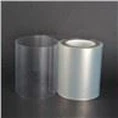




Clear Rigid PVC PVDC Sheet For Food Pharma Packaging
Vacuum Forming – The Process Reality
Vacuum forming is one of the oldest and most widely used thermoforming methods, but it has specific film requirements that are often misunderstood. Clear Rigid PVC PVDC Film For Blister Vacuum Forming is engineered specifically for this process, where the heated film is drawn into a cavity using vacuum pressure alone-without plug assist.
The Vacuum Forming Process (Step by Step):
| Step | Description | Why Film Properties Matter |
|---|---|---|
| 1. Heating | Film passes through oven, heated to forming temperature (120–145°C) | Uniform heating requires consistent thickness (±3%) |
| 2. Web Transfer | Heated film moves to forming station | Rigidity prevents sagging between stations |
| 3. Vacuum Draw | Vacuum pulls film into cavity (no plug) | High elongation (>180%) prevents cracking |
| 4. Cooling | Film cools in cavity, takes shape | Adequate cooling prevents distortion |
| 5. Ejection | Formed film is ejected from cavity | Good release properties prevent sticking |
| 6. Sealing | Lidding is sealed to formed web | PVDC layer provides seal surface |
Why "No Plug Assist" Changes Everything:
| Factor | With Plug Assist | Without Plug Assist (Vacuum Only) | Impact on This Film |
|---|---|---|---|
| Film stretch | Plug pushes film into cavity | Vacuum pulls film-more stress on corners | Requires higher elongation |
| Wall thickness | More uniform (plug helps spread) | More thinning at corners | Balanced orientation essential |
| Cavity depth | Deeper draws possible | Limited to 10–12mm | Thicker PVC needed for deeper cavities |
| Cycle time | Slightly longer (plug movement) | Faster cycle (no plug) | Speed advantage for high-volume production |
▸ Critical Film Properties for Vacuum Forming Success
When running Clear Rigid PVC PVDC Film For Blister Vacuum Forming, these four properties determine your success on the line:
1. Thickness Uniformity (±3% tolerance)
| Why It Matters | What Happens If It's Poor |
|---|---|
| Uneven heating – hot spots cause sagging; cold spots cause cracking | 10–15% scrap rate vs. <1% with uniform film |
| Variable draw depth – some cavities under-filled, some over-stretched | Rejects and line stoppages |
| Inconsistent seal strength – thin areas seal poorly | Leakers and returns |
This Film Delivers: Online beta gauge monitoring with closed-loop control; ±3% across entire web width.
2. Balanced MD/TD Orientation
| Why It Matters | What Happens If It's Poor |
|---|---|
| Film stretches equally in machine direction and transverse direction | Cavity corners thin excessively (cracking) |
| Uniform wall thickness across all four corners | Some corners white (stress-crystallization) |
| Consistent product appearance | Vision inspection failures |
This Film Delivers: Calendered with balanced orientation; MD/TD tensile ratio <1.2.
3. High Elongation at Break (>180%)
| Why It Matters | What Happens If It's Poor |
|---|---|
| Deep draws require high stretch without cracking | Web breaks during forming – line downtime |
| Cavity corners must stretch to match mold shape | Delamination between PVC and PVDC |
This Film Delivers: Elongation at break ≥180% (MD) – provides safety margin for deep draws.
4. Good Release Properties
| Why It Matters | What Happens If It's Poor |
|---|---|
| Formed film must release cleanly from mold | Sticking causes distortion, tearing, and downtime |
| PVDC coating provides smooth release surface | Need for mold release sprays (extra cost, contamination risk) |
This Film Delivers: PVDC surface has low surface energy, providing natural release. No release sprays needed.

Vacuum Forming Parameters – Recommended Settings
For Clear Rigid PVC PVDC Film For Blister Vacuum Forming, use these starting parameters:
| Parameter | Standard Grade | Deep-Draw Grade |
|---|---|---|
| Film Thickness | 250 µm | 300–350 µm |
| Pre-heat Temperature | 90–100°C | 95–105°C |
| Forming Temperature | 120–135°C | 130–145°C |
| Vacuum Level | –0.8 to –0.95 bar | –0.9 to –0.95 bar |
| Dwell Time | 2–4 seconds | 3–5 seconds |
| Cooling Time | 3–5 seconds | 4–6 seconds |
| Mold Temperature | 20–30°C | 20–30°C |
| Max Cavity Depth | 10mm | 12mm |
| Line Speed | Up to 250 cycles/min | Up to 150 cycles/min |
▸ Application Deep-Dive: Different Cavity Geometries
Clear Rigid PVC PVDC Film For Blister Vacuum Forming is versatile across different cavity shapes:
| Cavity Shape | Challenge | How This Film Performs |
|---|---|---|
| Round (circular) | Uniform stretching required; corners less critical | Excellent – elongation is uniform in all directions |
| Square/Rectangular | Corners are stress points – high risk of thinning | Balanced orientation ensures even thickness at all four corners |
| Deep (10–12mm) | High elongation required – risk of cracking | Elongation ≥180% provides safety margin |
| Shallow (3–5mm) | Less risk – easy forming | Excellent – fast cycle times |
| Irregular shapes | Uneven stretch – some areas thin excessively | Good – but we recommend a forming trial first |
| Multi-cavity | Consistent depth across all cavities | Thickness uniformity (±3%) ensures all cavities form identically |

Quick Reference – Vacuum Forming Selection Guide
| Cavity Depth | Recommended Thickness | Recommended PVDC Coat Weight | Max Line Speed |
|---|---|---|---|
| Up to 5mm | 200 µm | 35 g/m² | 300 cycles/min |
| 5–8mm | 250 µm | 40 g/m² | 250 cycles/min |
| 8–10mm | 300 µm | 45 g/m² | 200 cycles/min |
| 10–12mm | 330 µm | 50 g/m² | 150 cycles/min |
| >12mm | Deep-Draw Grade | 50 g/m² | 100 cycles/min |
Summary – Why Choose Clear Rigid PVC PVDC Film For Blister Vacuum Forming
| Your Vacuum Forming Requirement | This Film Delivers |
|---|---|
| Consistent forming without plug assist | Rigid PVC – stable web; balanced orientation |
| Crystal-clear product visibility | Haze <4% – no stress whitening |
| Moisture and oxygen barrier | PVDC coating – WVTR ≤2.0, OTR ≤5.0 |
| Deep-draw capability | Up to 12mm with standard grade |
| High-speed line compatibility | Stable web – runs at 250+ cycles/min |
| Pharma-grade quality | ISO 15378 certified – full traceability |
| Easy release from mold | PVDC surface – no release sprays needed |
| Regulatory compliance | FDA and EU compliant |

Extended FAQ – Vacuum Forming Specific Questions
Q1: What is the difference between vacuum forming and pressure forming?
Vacuum forming uses vacuum only to draw the film into the cavity. Pressure forming uses additional air pressure on the back side of the film, allowing sharper detail. This film works for both, but for pressure forming, we recommend slightly lower forming temperatures to account for the added pressure.
Q2: Why does vacuum forming sometimes cause haze in clear films?
Stress-induced crystallization – when film is stretched beyond its natural limit, the polymer chains align and crystallize, creating haze. Our formulation delays crystallization, keeping haze <4% even after forming. For extremely deep draws, we recommend our Deep-Draw grade.
Q3: Can this film be used on rotary vacuum forming machines?
Yes – the rigid web and consistent thickness are ideal for rotary machines (e.g., Bosch, Uhlmann). The film runs at speeds up to 250 cycles/min.
Q4: What is the maximum vacuum level recommended?
–0.95 bar is the maximum. Higher vacuum can cause over-stretching and thinning. We recommend starting at –0.8 bar and adjusting based on cavity depth.
Q5: Does the PVDC coating affect vacuum forming performance?
No – the PVDC coating is applied to the inner surface and does not affect the forming properties of the PVC base. Forming performance is determined by the PVC layer.
Q6: How does film thickness affect vacuum forming?
Thicker film (300µm+) allows deeper draws but requires more heating time and slower cycle speeds. Thinner film (200µm) runs faster but has limited draw depth. We recommend 250µm as the best balance for most applications.
Q7: Can this film be used with plug-assist forming as well?
Yes – while this film is optimized for vacuum-only, it also works with plug-assist. In fact, plug-assist reduces the risk of corner thinning, giving you more forming flexibility.
Q8: What is the shelf life of the film itself?
24 months when stored at 15–25°C, <60% RH, away from direct sunlight.
Q9: Can the film be printed before vacuum forming?
Yes – reverse printing on the PVC outer surface is recommended. Printing before forming ensures graphics are not distorted by the forming process. We offer inline printing services.
Clear Rigid PVC PVDC Film For Blister Vacuum Forming – the reliable, high-clarity film that delivers consistent vacuum forming results, PVDC barrier protection, and pharmaceutical-grade quality on high-speed lines.
Hot Tags: Clear Rigid PVC PVDC Sheet For Food Pharma Packaging, China, manufacturers, suppliers, factory, customized, custom, wholesale, low price, free sample, die cut pet film, Rigid PET Film For Blister Packaging, calendared pet film, sheet pet film, black pet film, residential pet film